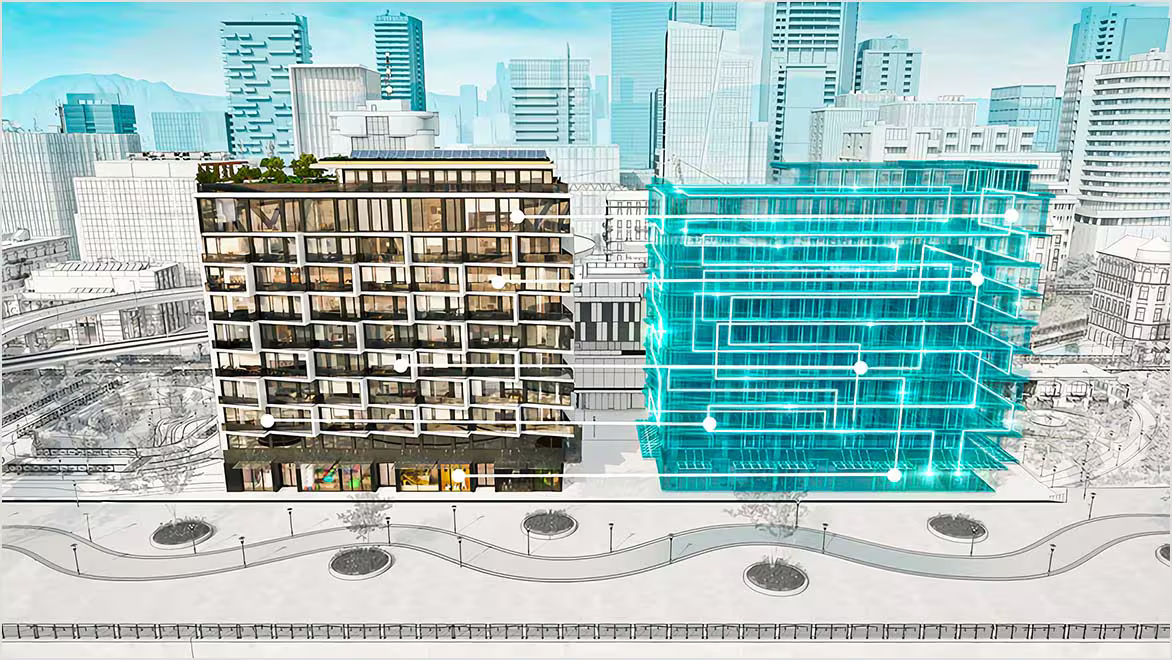
Implementing a digital twin in building automation offers unprecedented visibility and control, allowing teams to simulate, predict, and optimize building performance before making physical changes. That goal is becoming more attainable for building owners, facility managers, and system integrators.
But before investing, it helps to understand what a BACnet digital twin actually is, what it can realistically deliver in a commercial building context, and what infrastructure it depends on to work.
What is a Digital Twin?
A digital twin is a dynamic virtual replica of a physical building, system, or asset. Unlike a static CAD drawing or even a Building Information Model (BIM), a digital twin continuously updates in sync with its physical counterpart. BIM provides design geometry and asset documentation used during construction. A digital twin goes further—it integrates real-time sensor data, operational history, and predictive analytics to model how a building actually behaves in practice. As Sensgreen puts it, “BIM provides the blueprint”—a digital twin tells the ongoing story.

Building a functional digital twin requires four components, according to ThoughtWire: data from across the building’s systems, real-time contextual information about the building’s current state, a reasoning method (rules, AI, or machine learning) to drive decisions, and defined KPIs that align the model with meaningful business outcomes.
The result is a living model that can monitor, simulate, and respond—not just document. Take a six-minute deep dive into digital twins in this explainer by IBM’s Martin Keen:
What Can a Digital Twin Do for a Commercial Building?
In a building automation context, digital twins address problems that facility teams deal with every day: rising energy costs, reactive maintenance, lack of full system visibility, and the difficulty of communicating infrastructure health to non-technical stakeholders.
The performance numbers are significant. Buildings using digital twin technology have shown up to a 20% reduction in energy consumption, with maintenance cost reductions of 25–30%, according to Sensgreen.
Hysopt’s data shows organizations using digital twins report a 30–50% reduction in post-handover complaints.
Concretely, that means:
- HVAC and lighting systems are dynamically adjusted based on real-time occupancy and weather data
- Predictive maintenance based on continuous condition monitoring, not scheduled intervals
- Scenario modeling before committing to physical changes
- Retrofit and upgrade planning against a validated baseline
As Hysopt writes: “Digital twins aren’t optional for smart buildings—they’re foundational.”
Digital Twins and OT Network Operations
For most building automation pros, digital twins are still seen as expensive and complex 3D models of the architecture. But if you’re managing an OT network, the real magic is in the communication layer.
In a BACnet-heavy building, your network—the MS/TP segments, IP routers, and BBMDs—is the central nervous system. Using a digital twin to map out that specific topology is a total game-changer for a few reasons:
- Trial Runs for Network Extensions: Instead of adding new devices and crossing your fingers, you can model the changes first. It lets you check the network load and spot IP conflicts before you ever touch the live system.
- Checking Your Work (Commissioning): During a new install, the twin acts as your “source of truth.” It helps you verify that the real-world setup actually matches the design, catching glitches when they’re still cheap to fix.
- Better Troubleshooting: When systems start acting up, a twin fueled by real-time telemetry can flag degraded links or weird communication spikes that you’d otherwise spend hours hunting down.
- Stress-Free Upgrades: Whether it’s an HVAC retrofit or a tenant buildout, the twin gives you a solid baseline. You’ll know exactly how new equipment will play with the existing network, which means way fewer “unintended consequences” on go-live day.
Digital twins future-proof assets over the long term. When you apply that to the OT network layer, it stops being just a record of what you have and starts being a map for where you’re going.
The Network Is the Foundation
A digital twin is only as reliable as the data feeding it. In a BACnet building, that means the OT network must be operating cleanly—devices communicating without packet loss, MS/TP segments free from collisions, routers moving traffic without bottlenecks, and no malfunctioning devices introducing noise into the data stream.
If the OT network has unresolved issues—dropped packets, polling errors, bandwidth contention—the digital twin reflects those problems. Garbage in, garbage out.
There is also a diagnostic gap to account for. A digital twin can tell you that a zone is underperforming or that an HVAC system is not meeting its setpoints. It cannot tell you whether the root cause is a BACnet communication fault on the MS/TP segment feeding that zone. That requires dedicated OT network diagnostics—the kind that work at the packet level, not the application level.
This is where OptigoVN provides value. Before a BACnet digital twin can be trusted, the network layer it depends on must be understood. OptigoVN captures and analyzes BACnet traffic at the packet level, giving your team the visibility to verify network health, identify communication faults, and confirm that the data flowing into your twin is accurate. It is the diagnostic foundation that makes the rest of the digital twin investment worthwhile.
A BACNET digital twin promises unprecedented visibility into your building. Make sure the network underneath it earns that trust first.
Where Do You Start?
Building a digital twin is not a plug-and-play project. It requires integrating data from multiple building systems, establishing real-time data pipelines, and defining the models and KPIs that make the twin useful rather than just complex.
For most facility teams, the practical starting point is incremental. Even partial sensor data—temperature differentials, pump speed, room temperatures—can help validate and refine a twin model. Comprehensive sensor coverage is not required on day one.
For new construction, the ideal approach is to incorporate digital twin planning from the design phase, using BIM as the geometric foundation and layering simulation and control logic on top. For existing buildings, digital twins are particularly useful when documentation is sparse and performance needs to be demonstrated rather than assumed.
In either case, most organizations benefit from working with specialists in digital twin implementation. The integration complexity across BAS, IoT platforms, and data modeling tools is high, and errors in the underlying data model propagate into every decision the twin supports.
Before that work begins, your OT network needs to be in order. Register for a free OptigoVN account and get the packet-level visibility your BACnet network needs before your digital twin depends on it.