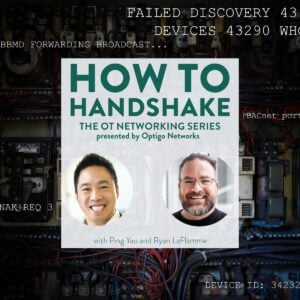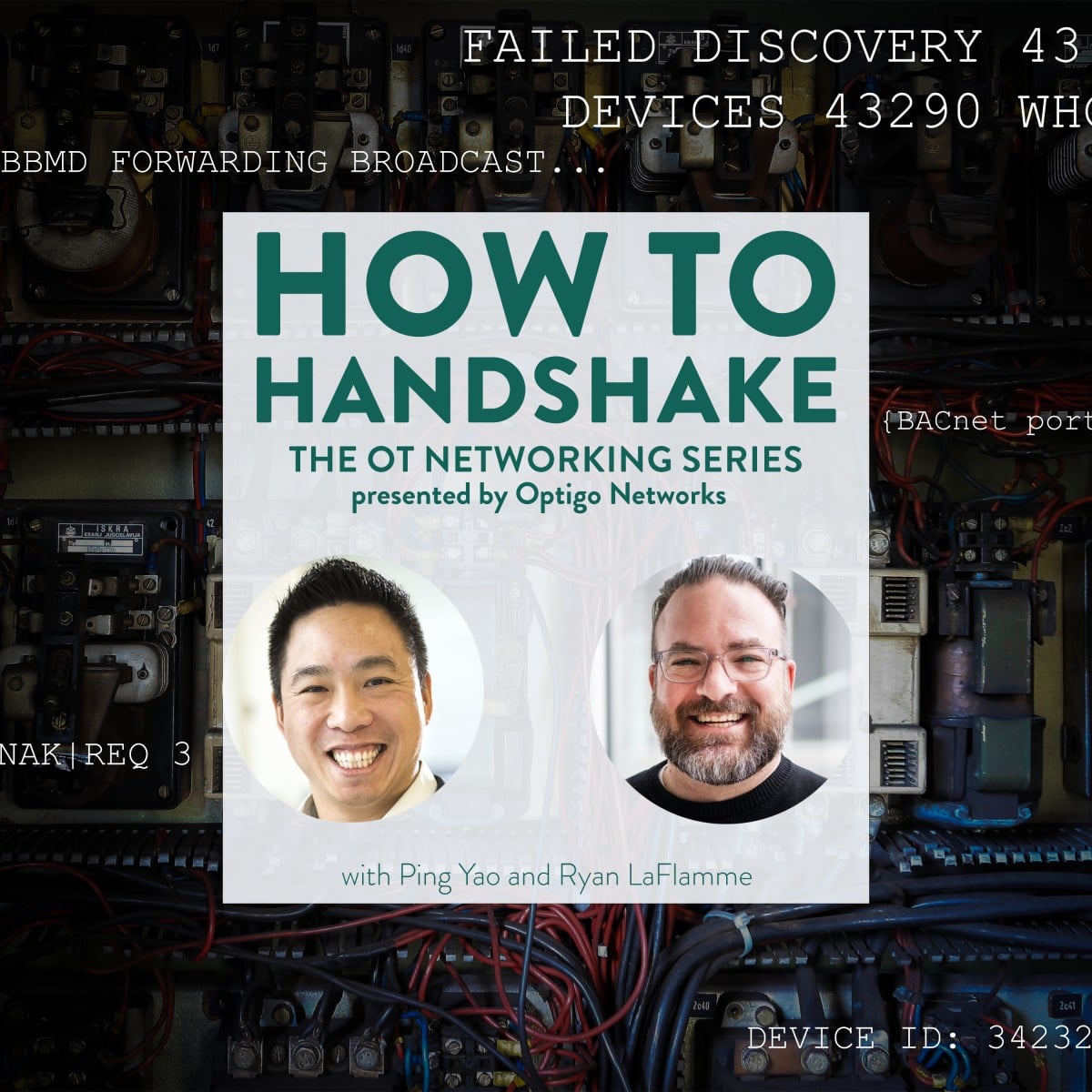
Welcome to the very first episode of How to Handshake, Optigo Network’s brand-new podcast series!
In this show, we’re going beyond the manual. Hosted by Ping Yao and Ryan LaFlamme, we’re bringing together the brightest minds in OT to have the conversations that actually matter to people working on building automation—no vendor pitches, just real talk about the state of the industry.
Subscribe to the Podcast on Apple Podcasts, Spotify, Deezer, and YouTube!
Energy Efficiency is No Longer Optional
In our premiere episode, we’re joined by Aaron Hastings from Apex Consulting and Alex Waibel from BuildingLogix. We dive deep into the growing demand for energy efficiency and how the OT network has shifted from a “background utility” to the absolute foundation for energy-saving success.
In this episode, we’re tackling:
-
Energy as a Service (EaaS): What it is and why it’s changing the way facilities manage their budgets.
-
The Foundation of Efficiency: Why you can’t have a green building without a healthy, high-performing OT network.
-
Overcoming Data Silos: How to get the data you need from your hardware to make meaningful energy decisions.
-
Real-World Success Stories: How Aaron and Alex are helping clients turn network insights into measurable carbon reductions.
Watch the full episode here:
We want to hear from you!
Since this is our first season, we want your input to help shape where the show goes next. What topics, debates, or technical questions in the OT space do you think deserve a deeper dive?
Send us a message on LinkedIn, Reddit, or Bluesky, or email us at marketing[at]optigo.net.
Transcript:
Ryan LaFlamme: It’s episode one of How to Handshake, Optigo Networks’ new podcast. On this week’s show, Aaron Hastings from Apex Consulting and Alex Weibel from BuildingLogix join Ping and I to talk about the growing demand for energy efficiency in buildings. We’ll also talk energy as a service and how the OT network has become a foundation for energy saving success. I’m Ryan LaFlamme and this is How to Handshake, Episode One.
Ryan LaFlamme: Hello, everybody listening and watching. I’m Ryan. This is Ping. Hi Ping!. We’ve been away for a little bit, but we’re back now with a new format and a new name. This is How to Handshake. We are debuting a new podcast version of the show, which is very exciting. You’ll be able to pick it up anywhere you get your podcasts—Apple, Google, Spotify, all of those great places. So look for that, and our videos will continue to be hosted on the Optigo Networks YouTube channel.
Ryan LaFlamme: Like we said, we’re going to be adding new guests, which is a lot of fun. We felt there was a lot of great discussion during the break, and that sparked this retooling. There are a lot of people out there who are really smart and have great ideas for where the industry is heading. We really wanted to bring people in.
Ping Yao: Absolutely. We have great members of our community who have amazing stories and amazing pieces of information. I always felt there was a lack of exposure to these great case studies and ideas. I’m really excited for this new way we’re doing these podcasts and giving people a platform to give their own thoughts.
Ryan LaFlamme: Let’s jump right into it. Being episode one, we are joined this week by Aaron and Alex. Aaron is a consultant with Apex Consulting, and Alex is the president of BuildingLogix. We are going to talk about energy efficiency and the increasing demand for it in buildings. We’ll bring it back to how having a good OT network is critical to achieving that. I think it’s Alex who said you can’t build a beautiful house if the foundation is uneven and cracked.
Ping Yao: That’s right. We are the foundation. The network is where everything gets carried over, and if that doesn’t work, all these other methods and applications don’t work.
Ryan LaFlamme: Without further ado, let’s go around the room and have you say who you work for and what you do.
Aaron Hastings: I’m Aaron Hastings, the president of Apex Consulting Systems. I help facilities and portfolio managers find a cash flow positive path upgrading their building automation systems and other infrastructure. I find them a little cash, and then I help them make the upgrades they’re looking for.
Alex Waibel: I’m Alex Waibel, the president at BuildingLogix. We’re a technology business that works with contractors, engineers, and end users, helping them make smarter decisions around infrastructure for energy and operational efficiencies.
Ping Yao: Most of you likely would have seen my face; my name is Ping, and I’m a co-founder and the CTO for Optigo Networks. My day-to-day is writing code and looking at what customers need. My background is in networking, and I stumbled into the world of building automation 12 years ago.
Ryan LaFlamme: Over the last few years, energy efficiency has become far more important to the industry through internal and external pressures. What better time to talk about the role of OT networking in helping create the conditions for energy efficiency. How do you see that role?.
Ping Yao: In my view, the concept of the OT network when it comes to energy efficiency is a degree removed. For those embarking on net zero programs, the network is an afterthought. They come up with an initiative and then realize, “Oh wait, we need to connect these things”. I think the networking discussion should be on the table right after the owners decide to embark on this.
Alex Waibel: I think it requires context. In new buildings, the connection exists, but we deal a lot more with existing buildings where the infrastructure is an afterthought. The people managing those buildings still have to deal with lights and moving from T12s to LEDs. The connection is more inside of new construction or heavy retrofit than in trying to drive efficiency in existing buildings.
Aaron Hastings: I find the relationship is very close depending on the context. You can do energy efficiency locally with Ashrae Guideline 36, but if you need to scale that to hundreds or thousands of buildings, you need to be in tune to the specifics of individual sites. Some MS/TP trunks are overloaded before you even look at them. You need someone who has had their hands in it to assess appropriately. Often, you can get great interaction out of existing systems depending on how you implement it.
Ryan LaFlamme: How do we utilize granular data from networks and BACnet traffic to maximum effect, and where are we failing to get data that is already out there?.
Ping Yao: Alex, in your experience, do most energy programs just use three-month-old utility bills, or are we now seeing the use of near real-time granular data?.
Alex Waibel: In higher education and healthcare, they usually already have a meter infrastructure pulling data in on an incremental level, like 5 to 15-minute data. There are exceptions still working off utility bills, but not many. Larger property owners who understand the property as an investment vehicle look at these things to drive cost out and increase revenue potential.
Aaron Hastings: Ping is asking about using real-time data to decide how you will or will not do something, and that does happen, though not frequently enough. It implies things like demand response where the utility says they are overloaded and need you to shed load in return for a cut on your bill. But that means you need an independent power source or you have to tolerate no comfort for three hours, and many customers aren’t in a position to do that.
Alex Waibel: In some cases, rates aren’t going up, but the structures are changing, especially where many AI data centers are being built. I had a conversation today with a client in West Virginia who has seen utility rates skyrocket recently, moving from a single demand charge on a monthly basis to a daily basis. We’ve seen utility rate increases anywhere from 50 to 500% on the demand side. That’s significant if you’re running manufacturing or large chiller plants.
Aaron Hastings: It’s not just the cost per kilowatt hour; if you exceed a certain usage, your delivery charge is more. People are trying to avoid “ratchet rates”. There is also an opportunity to use interval data from electrical meters on your plant to run an AI that drives down kilowatts per ton, which requires real-time meter reads locally. That still travels over the wire.
Ryan LaFlamme: How should we structure our OT network to gather that data and prove that these energy efficient changes are actually working over the long haul?.
Ping Yao: We run into projects where they’ve spent lots of money on an energy program and got very little return because the system they installed it on is not capable of sustaining it. Underlying problems get amplified when you attempt improvements. These programs have to keep system engineering in mind. For us, the best way to look at health is to monitor the traffic that goes across the network.
Aaron Hastings: You have to know what it’s doing; there’s no way to just guess. If you can do something that only pings 20 points every 15 minutes, you have a good chance. Strategy and implementation are important. A good automation guy should be able to tell you if an electrical meter is popping offline several times a day, but unfortunately, there isn’t a lot of good training in the industry. A lot of times what you need is off the MS/TP trunk, and people don’t know they are missing something because they don’t understand the mechanics.
Ping Yao: You have to make sure your underlying fundamentals are good. You can start with high impact things that have a low impact on your network to save money, then use those savings to invest in staged rollouts down the line.
Alex Waibel: In our first engagement with Optigo, we were working with a large campus. We used your tools to understand how well the network was passing data and recognized early on that there were problems we didn’t want to take ownership of before putting our application on there. You have to get the network in a position where the data coming is reliable and consistent. If the data isn’t sound, it’s hard to make the right decisions.
Aaron Hastings: A lot of times we have the data, it’s just a matter of whether we can get it reliably. I often go into individual systems and check diagnostics the hard way, but I have used Optigo before. There was a site with 300 devices where broadcasts were happening from the same device via IP and Ethernet, which is a router loop and made the IP side grumpy. Benchmarking is critical, and in a large building, it isn’t feasible without a tool like Optigo.
Ryan LaFlamme: What are some effective ways to identify “zombie loads”—equipment communicating on BACnet that isn’t actually serving anyone?.
Aaron Hastings: Trending is key. On smaller systems, you can look at individual automation trends, but for the network, it’s important to have COVs set properly. I find a well-done polling network tends to do just fine most of the time.
Alex Waibel: For the university I mentioned, using Optigo has become our standard practice. We offer the tool and our expertise as a service because not a lot of people are capable of doing it. I can’t just look at one new building because it’s connected to a campus network where a 50-year-old building might have duplicate device IDs. We’ve incorporated your technology to make sure the data is clean before we add new elements and more finger-pointing begins.
Ping Yao: How often do you see buildings initiate energy analytics and then abandon it after a year or two?.
Alex Waibel: Often, people say they have it connected, but it’s only a small number of buildings because of scaling challenges and licensing structures.
Ping Yao: I know you both get pulled in as the “savior” when customers engaged in a program five years ago and didn’t get the outcome.
Aaron Hastings: Yes. Before I was a consultant, I was the one trying to implement these things and realizing it was nuts. We had a site where they were told SkySpark would save them all this money, but after ten months they realized they didn’t have the manpower to fix the stuff on fire, much less the “sparks” in SkySpark. Often these programs don’t scale well across a portfolio because each building is a snowflake.
Alex Waibel: We talk people, process, technology—in that order—for a reason. Technology is just a tool; you need people to drive it and processes to standardize it. You have to start small, prove it works, and then find another place to bite off.
Ryan LaFlamme: It seems we agree that it’s not a failure of having data, but knowing what to do with it—the difference between insights and actionable insights. Without outside expertise, you end up with reams of data and no idea what to do with it.
Alex Waibel: Data is like the phonebook; we have to convert it into actionable information. Identifying what needs to be done isn’t measured in days, but completing it can take months because of limited resources and scheduling buildings.
Ping Yao: From our side, we don’t always see the realities of the projects. Solutions can be solved by bug fixes, but these guys are up a ladder with a multimeter.
Alex Waibel: I take our virtual technicians out into the field so they can see the realities. One technician’s takeaway was that he had no idea how much those guys walk in a day—four to five miles—and how many times they are interrupted as soon as they step into a hallway. No wonder he can’t remember if he fixed something. We have to be clear about priorities.
Aaron Hastings: I tend to get an eyeball scan of a room and might see that an outdoor air louver is too close to a generator—mechanical issues you won’t see in a graphic. It really helps when implementing energy measures to know if the mechanicals are even right. When you prioritize for the guys on the ground and stop inundating them with unhelpful info, they love you for it. You can touch things they didn’t even realize, like why a steam hammer is happening.
Ping Yao: I observed two things when I visited: the reliance on non-digital information, like stickers on a box for device IDs, and the acceptance of mediocrity. Someone clicks on a graphic and says “just be patient” because it hasn’t worked for six months, and they just walk over to look at a physical thermometer instead.
Ryan LaFlamme: Wrap-up question: MS/TP—is it still worth having around, or is it time to move away? And what are the benefits of migrating MS/TP to BACnet IP?.
Ping Yao: Today, the difference in price between MS/TP and IP-based controllers is almost nothing. The cost argument for installing MS/TP no longer applies in my opinion. New construction should not have MS/TP, with exceptions for distance.
Alex Waibel: If they build out an IP network, it must be an OT network isolated from the business network for cybersecurity. On existing buildings, don’t replace something that isn’t broken. If you’re adding two or three controllers, I’d probably just extend the MS/TP because it’s less of a pain.
Aaron Hastings: MS/TP has security by obscurity, and it’s physically impossible to transmit most malicious things over it. If your organization doesn’t have the ability to take advantage of IP, MS/TP is the preferred cybersecurity posture. But T1L is coming out, which takes existing two-wire networks and makes them Ethernet. It’s ten megabit, but that’s more than we need and it allows you to squeeze more out of existing hardware. Honeywell and Delta have been out with it, and it seems anyone with a head on their shoulders is trying to get into that game.
Ping Yao: For clarity, T1L doesn’t extend the life of MS/TP, it just extends the life of the wiring. It gets you ten megabits, which is a thousand times faster than MS/TP. It is packet-based and point-to-point.
Ping Yao: When we talk about energy analytics, you come up with changes to reduce costs, which is a “write” to the system. But gathering the data is the “read” side. Why view it continuously?.
Aaron Hastings: Every energy saving project functions on the premise that it will pay for itself, and the only way to know is by gathering the data to prove it. I have a case study for the DOE where we have to show the kilowatts per ton going down to prove it pays for itself in a certain amount of time.
Alex Waibel: Lighting energy savings are instantaneous, but on the mechanical side, every building is a snowflake. As soon as someone makes an adjustment because they are uncomfortable, they can eliminate the savings or start costing more than before. That’s why collecting data after implementation matters.