There is a growing web of compliance obligations driven by evolving cybersecurity standards, privacy regulations, insurance requirements, and sustainability mandates. OT networks are increasingly scrutinized under these regulations. Without proper oversight and documentation, building owners risk delays, fines, or even legal exposure
That raises critical questions:
- How do you prove your building’s OT systems are secure and well-maintained?
- Can you provide historical data for system uptime and diagnostic results?
- Are you prepared for an external audit or insurance review of your infrastructure?
Let’s discuss how compliance pressures reshape expectations for smart building operations and how the right OT monitoring platform can make all the difference. OptigoVN can help building owners easily stay compliant, simplify those audits, and prove they’re managing their systems proactively.
If compliance has ever felt like a moving target, OptigoVN might be the solution you’ve been looking for.
Navigating OT Reporting and Auditing Requirements
The web of modern requirements can seem impossible. This is a just sampling of some of the various legal and industry requirements many building managers have to report on:
Cybersecurity Standards
Frameworks such as the NIST Cybersecurity Framework (CSF) are widely adopted as best practices for protecting critical infrastructure. While not always legally mandated, they are often referenced in contracts or insurance agreements. These frameworks call for demonstrable security controls and continuous monitoring of systems like building automation and BACnet environments.
Data Privacy Regulations
If building systems such as access control, security cameras, or visitor logs handle personally identifiable information (PII), data privacy laws like GDPR in Europe or CCPA in California may apply. These regulations require technical safeguards and audit trails to protect sensitive data, even within building automation systems.
Insurance and Liability Requirements
Cybersecurity insurance policies are increasingly scrutinizing the OT side of building systems. Insurance providers may require proof of active monitoring, vulnerability management, and incident response capabilities. Being able to document how your OT systems are secured and maintained can significantly influence your premiums or determine whether you’re eligible for coverage at all.*
Here’s an example: A commercial landlord applying for cyber insurance is asked to document how they monitor their OT infrastructure. Without a centralized monitoring tool, gathering that evidence from individual contractors proves time-consuming and inconsistent, delaying policy underwriting.
Governance and 3rd Party Risk
Auditing requirements have expanded beyond finance and IT. Many enterprises now conduct internal audits of their building environments, especially in multi-tenant buildings where OT systems impact tenant operations. These audits often evaluate the security, reliability, and documentation practices of OT networks.
For example, a data center tenant requires proof of regular building system fault and anomaly reviews. However, the building owner lacks centralized records and cannot consistently demonstrate a monitoring process, which is impeding lease negotiations.
Energy, Sustainability, and Performance Compliance
Compliance with local energy ordinances and building sustainability programs often depends on clean, accurate data from OT networks. BACnet devices must be correctly configured to deliver reliable metrics for energy use, indoor air quality, or system performance. Misconfigured devices can flood the network with unnecessary traffic, causing data loss and noncompliance with reporting mandates.
Standards like ASHRAE 135, which governs the BACnet protocol, outline how building systems should communicate. Network monitoring tools that identify noisy or non-compliant devices are critical for staying within acceptable thresholds.
Hypothetical example: A municipal building must report annual energy usage to meet local performance requirements. A misconfigured BACnet device floods the network with WHO-Is traffic, corrupting energy data and triggering an audit request.
Industry-Specific Compliance Mandates
Certain buildings—such as those with healthcare, financial, or government tenants—face additional regulatory pressures. For example, healthcare facilities must comply with HIPAA, and government-leased spaces may be subject to federal cybersecurity directives. Guidance like NIST SP 800-82 helps standardize security practices for industrial control systems, including building automation.
It’s easy to see: A mixed-use building includes biotech tenants whose operations depend on secure access control and strict environmental controls. If network instability causes downtime or exposes sensitive system data, the building owner may be asked to demonstrate safeguards and risk controls under state privacy laws.
The Solution? Stream the Auditing Process
Audits, whether internal or external, demand evidence. Manually gathering logs, network diagrams, and device lists from disparate building systems is time-consuming, error-prone, and stressful.
- Provide a single source of truth for your OT network inventory, topology, and health status so auditors can quickly understand the environment.
- Illustrative evidence of network segmentation, device health, or identification of connected assets
- Reporting or allowing data export making it easier to generate the documentation required by auditors.
How OptigoVN Supports Compliance and Audit Readiness
1. Centralized, Timestamped Historical Records
OptigoVN’s traffic capture tools can continuously upload BACnet network activity. These packet captures are timestamped and stored securely in the cloud, enabling a verifiable digital record of OT network behavior over time. This is especially important when demonstrating consistent monitoring practices or proving when and how issues were resolved.
These logs can support audit questions like:
- Can you show how long this broadcast storm lasted and when it was resolved?
- Do you have historical data showing device uptime?
- How frequently is the OT network reviewed for anomalies or security risks?
2. Automated Reporting and Export Tools
Auditors and compliance officers often require formal documentation of system behavior across specific periods. OptigoVN allows users to export standardized reports that can be shared directly with internal compliance teams, external auditors, or insurance underwriters.
These reports can answer audit questions like:
- Do you conduct and retain regular reports on OT system health?
- Can you provide documentation for OT network activity over the last 90 days?
- What types of anomalies were detected in the last quarter, and what action was taken?
3. Granular Access Controls with Site Scope+
One feature of OptigoVN’s Site Scope+ feature lets building owners share specific data views with external stakeholders without compromising the security or integrity of the full system. Access ideal for auditors, IT teams, or compliance consultants.
Controlled sharing satisfies audit questions like:
- How do you ensure third-party access to OT data is limited and secure?
- Can our audit team view current and historical diagnostic data without needing admin access?
- What safeguards are in place to prevent overexposure of network information during investigations or vendor reviews?
4. Evidence of Proactive Issue Resolution
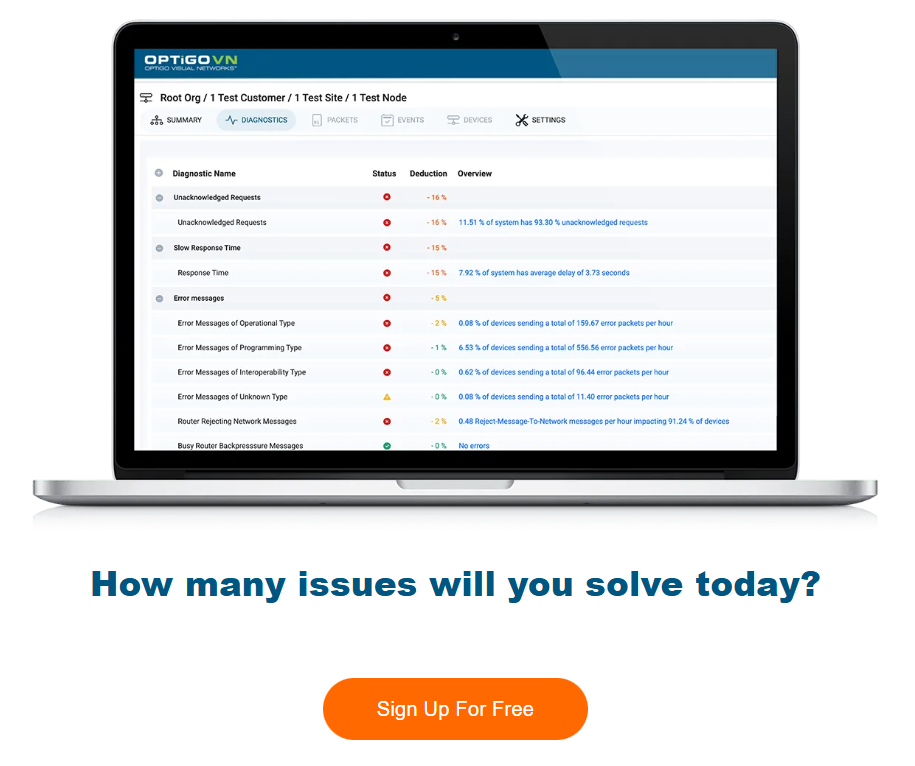
Many compliance frameworks—including NIST and ISO/IEC 27001—require that organizations not only monitor their systems but also take timely, documented action to resolve issues. OptigoVN provides clear evidence of proactive OT network management, including alerts for excessive broadcast traffic, misconfigured devices, and other performance-degrading events.
Combined with OptigoVN’s historical logs and export capabilities, this creates a defensible record of operational diligence. Whether for cybersecurity insurance, internal IT audits, or smart building performance standards, building owners can show that they’re not just monitoring problems—they’re addressing them.
This supports audit questions like:
- How do you identify and respond to OT system issues before they impact operations?
- Is there documentation showing how recurring faults or risks were mitigated?
- What visibility do you have into broadcast storms or device-level conflicts, and how are those issues tracked over time?
- Can you demonstrate a consistent process for OT network diagnostics and follow-up?
Stay Ahead of Compliance with Confidence
The pressure to meet OT compliance standards isn’t going away—but with the right tools in place, it doesn’t have to slow you down. Optigo Visual Networks simplifies how you monitor, document, and report on your OT infrastructure, giving you the visibility and traceability needed to stay ahead of audits, insurance reviews, and internal governance.
With Optigo Visual Networks, client OT network monitoring and troubleshooting just got easier. To find out for yourself, click here to request a demo, or create your free account and start exploring today.
*OptigoVN is an OT network monitoring and diagnostic platform. It is designed to provide visibility, repair, and optimization into the health, performance, and behavior of your OT infrastructure. OptigoVN does not provide managed cybersecurity services, vulnerability assessment, threat detection, or incident response services. OptigoVN offers deep packet analysis, centralized historical records, and active device inventory to support security investigations and audits.