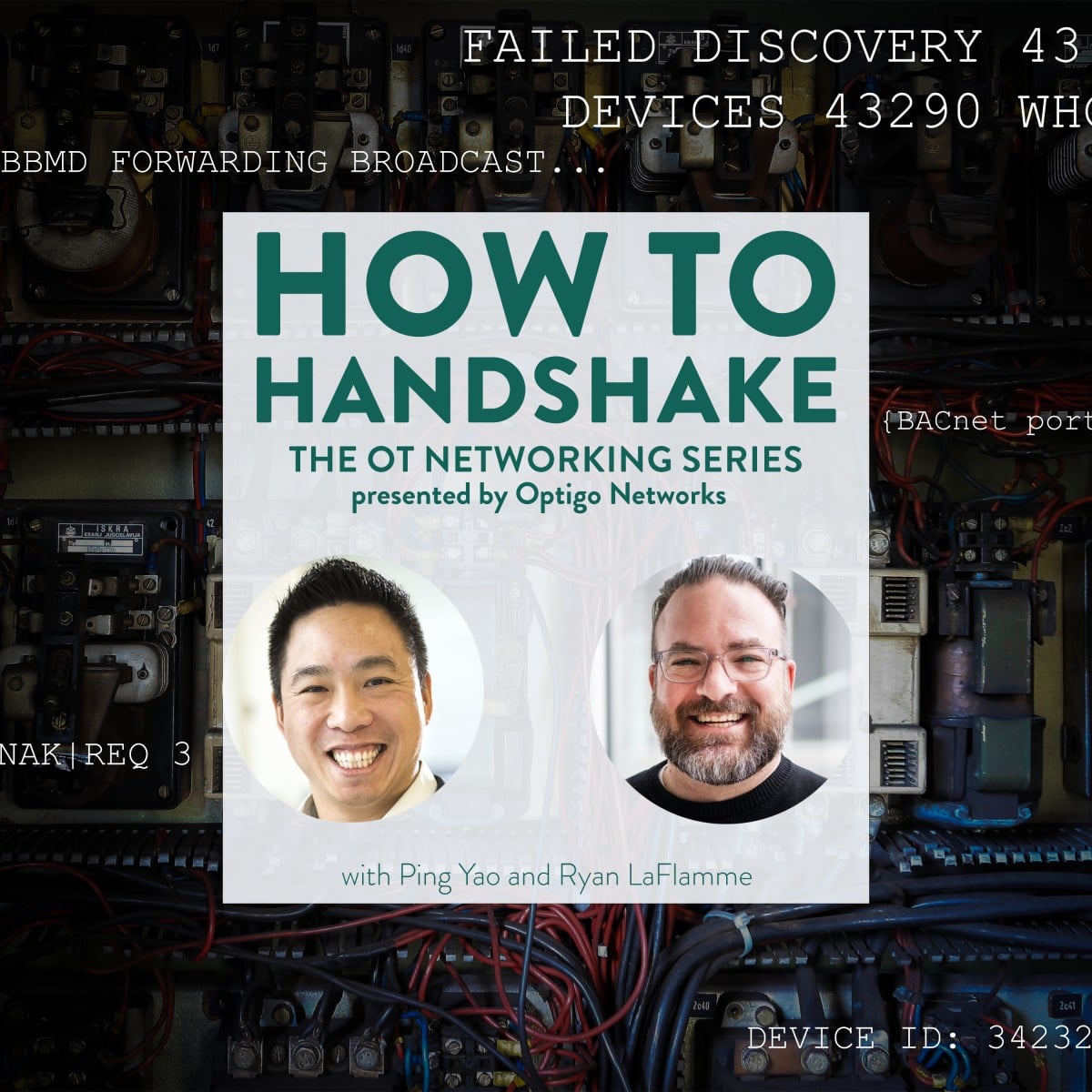
Welcome back to How to Handshake, Optigo Networks’ podcast series on OT networking, building automation, and the conversations that actually move the industry forward.
Subscribe to the podcast on Apple Podcasts, Spotify, Deezer, and YouTube!
A Career in OT is Still Worth It, So How Do I Get It?
In episode five, we’re joined by Jon Spooner and Mike Conway, co-founders of Stacks and Joules — the New York–based nonprofit running a 14-week bootcamp that turns very new talent into BAS field technicians, with a 92% post-graduation placement rate.
Which certifications are actually worth chasing, and which ones are mostly marketing? What’s the real story behind the skilled labor shortage we keep hearing about? With all the AI noise out there, will these jobs even be here in five years? And what does an OT job actually look like on a Monday morning — laptop, multimeter, ceiling tiles, or all three?
Watch the full episode here:
What topics, debates, or technical deep-dives do you think this show needs to cover? Send us a message on LinkedIn, Reddit, or Bluesky, or email us at marketing[at]optigo.net.
Transcript:
Ryan LaFlamme: On this week’s show, we’ve pulled together a panel to tackle the question that just about everybody coming into this field eventually asks — is it still worth it? Which certifications are actually worth chasing, and which ones are mostly marketing? What’s the real story behind the skilled labor shortage we keep hearing about? And with all the AI noise out there, will these jobs even be here in five years, or will they look completely different? I’m Ryan LaFlamme, and this is How to Handshake, Episode Five.
Ryan LaFlamme: With me is Mike and Jon from Stacks and Joules, and as always, Ping. Ping, how are you doing this week?
Ping Yao: Excellent, Ryan. Thank you.
Ryan LaFlamme: We’re talking this week about the OT job environment — training and certification. And I thought, what better people to have on the show than people who do this for a living. Jon and Mike, please introduce yourselves and tell us a little about Stacks and Joules.
Jon Spooner: I’m Jon Spooner. I’m one of the co-founders of Stacks and Joules. I really came to Stacks and Joules through a long career in technology — I was last working for Google, doing urban-technology work in New York City. I saw the opportunity growing in Internet of Things and the need for that kind of hardware and software ability, and it really showed up as a great opportunity for a lot of entry-level jobs. My best friend from second grade, Mike Conway, happened to talk to me about this really wild idea.
Mike Conway: Jumping in there — my background is education. I taught high school math for over twenty years, and then started to work with public high schools developing career and technical education pathways. I worked with the ones building engineering pathways. I’d always done project-based learning, making math real. I’d often go to my best bud, Jon — right on the cutting edge of so much that’s going on — to get ideas and connections. It developed across that way into Stacks and Joules, first as a sample project for some of those schools I was working with. When we saw it really had legs, we branched off and started Stacks and Joules.
Ryan LaFlamme: What are some of the programs Stacks and Joules offers now?
Mike Conway: A real focus now is on young adults and adult learners — that direct-to-workforce pathway. Our core program is a 14-week bootcamp-style training program. We’re a nonprofit, and the mission part of our work is who we serve. We’re committed to serving people who haven’t had opportunities in this space. They’re typically coming in with little to no technical, formal background. Our only requirement is a high-school diploma or equivalency. So it’s really focused on bringing very new talent into the space.
There’s a practical side to that, too. Given the demographics of our country, there are smaller generations coming in. So not only do we have the “gray tsunami” of retirement, we have smaller generations to fill and support those roles. We’ve got to reach into places we haven’t typically looked for talent — and we’ve had great success with that.
Jon Spooner: The other side of the coin is that this industry is AI-proof. For this young generation, that is a real and honest concern: am I going to go after this job because it may be evaporated by some new tool? Looking at that human moat — if you have to touch something, it’s AI-proof. That’s where we saw a lot of strength in this opportunity. It wasn’t just, “Here’s a job, and oh, we’ll see what happens to it.” Real estate and building automation is something that cannot be impacted in that same way. That gives stability.
Mike Conway: On the AI point — these roles are really enabling AI in the built space. That BAS field technician, which is what our training focuses on, is really about establishing and then maintaining the flow of data, back and forth. Data is what AI feeds off. So they’re feeding the AI models and making sure they’re getting consistent, reliable, verifiable data. And there’s so much play in this space because of that — they’re engaging in the use, and even the development, of AI agents for different tasks, kind of accelerating the pace of the training. They’re able to do more complex work with the support of AI in a shorter amount of time.
Ping Yao: Ryan, I may take us a little off track from what you have written, but I want to add two and two together. You just said this industry is AI-proof, and I’d qualify that — it’s at least AI-proof for a little while. We don’t know where AI is going to go, but for now it is definitely more robust against the current disruption that GenAI is providing. The people coming in, the people you’re training — whether they’re using that as the reason or not — does it mean they’re looking for more hands-on, or more of the technology side? Because, you know, there’s the writing-the-agent side and then the pulling-the-wire side.
Jon Spooner: The tech is the appeal. That is the job that appeals to them. Very much so, because it’s been in their head, “Oh, you go into tech, you make money, you do cool stuff.” So the tech side is definitely one piece. But the in-person nature — for these students, they’re creatures of the urban environment. They love New York City. To them, the coolest thing is to throw their laptop in their backpack, get on the subway, show up to some humongous building, go in through the secret door, and be the smartest guy in the room. That is their dream, and we are delivering that to them. Empire State Building. Natural History Museum. The places they went to as kids — some of the most iconic buildings in the world — and we’ve got graduates going in there to troubleshoot and revamp their systems.
Mike Conway: Coming back to what they’re looking for — the most common type is very comfortable with technology and sees the opportunity, but gets a little antsy just sitting at a computer all day. They like that combination of skills Jon was describing. But we do get some who come in with a CS degree or an engineering degree and are still sort of struggling to find a meaningful job. Those CS degree holders usually go into more purely programming roles — or maybe a graphics-for-BAS role.
Ryan LaFlamme: This is a great way to set the table. One reason I wanted to do this episode is that this conversation keeps coming up every six months. If you look at any automation threads on Reddit, anything around BACnet, HVAC Talk — the questions always revolve around, “Thinking about making the jump to X, thinking about getting into this career, where do I need to start?” Before we get into specific career paths: when we talk about OT, operational technology, what does that job actually look like on a Monday morning? Are we talking laptops writing controller logic? Are we tracing wires and crawling through ceilings? Or both?
Mike Conway: Very much the crawling-in-the-ceiling, troubleshooting, following wires, building panels — that’s the classic on-ramp, getting that familiarity. Although it’s more like what’s common now with car mechanics, especially with EVs, but even with conventional cars. The first thing they do is plug into a computer and get diagnostics. The diagnostics don’t tell you exactly what the problem is, but they tell you it’s a fuel-air-mixture issue, and then you have to know, “What could be affecting the fuel-air mixture?” There’s a variety of things, and you go dig deeper. That’s the experience. It’s the combination. The diagnostics send them into the field — “We’re not getting data for this device” — they do detective work on their laptop, hone in on it, then get in there with their multimeter and figure out which of the variety of things is actually causing the problem.
So when you say OT, they have to know the variety of common issues. Some of this is very basic: is the device ID matched with the correct IP, with the correct MAC address? When an update was done, is it still communicating via the correct port? That’s two of the top five error diagnostics we see.
When you think of IT training, it’s a really broad approach. In this role, our approach — and how we turned it into a bootcamp — is working constantly with the companies doing this work and updating the curriculum. What are the most common issues your technicians are encountering? Our expertise is to look at those issues and identify the ones we know we can train a very new person to understand and rectify quickly. It’s a very targeted approach, but it sets them up.
Ryan LaFlamme: I like that. It’s the inverse of what you’d normally see. Instead of teaching all the theory and then hyper-specializing as you get more advanced, you’ve deconstructed it: here are the core issues, what do you need to understand them, what do you need to get to work. That’s a really interesting approach.
That goes to the skilled-labor-shortage conversation. I’m of the opinion — and I think Ping is too — that it’s a real thing. You laid it out: a swath of people retiring, taking a lot of institutional knowledge with them, and a lot of sea change happening in the industry. How real do you see that shortage on the ground? Is it training? Is it just getting your foot in the door? What are you seeing as the barriers?
Jon Spooner: It’s an industry constrained by labor and workforce. Market penetration is starting to creep downward in terms of building size — it’s starting to get into residential — but there are still huge swaths, especially small and medium-sized buildings, where it just hasn’t penetrated. All of these systems, the hardware and software, are designed by highly skilled engineers, and they require highly skilled engineers and technicians to implement and maintain. That’s expensive. That’s why it’s constrained to larger buildings where the margins are there. There’s this huge opportunity to open this market up by bringing down the labor cost. To do that — and we have some initiatives working on this — it’s a redesign at the hardware, software, and process level, so it can be done with our entry-level talent. That’s going to open up a huge market, and it’ll become the on-ramp to those continuing roles where the extra level of technical expertise is still required.
Ping Yao: Quick side question. As long as I’ve been in this industry, we’ve talked about labor shortage and skill shortage. Students — young or older — that go through your program: what’s the placement rate? The reason I’m asking is, if your placement rate is very high, then clearly there’s no oversupply.
Mike Conway: Yeah, totally. It’s very high. We have high graduation rates, and of those who graduate, about 92% are employed after graduation. Within the built-environment roles, the primary one is directly as a BAS field technician. We have some starting to go into logistics for a BAS company. And we have some who come in and decide they really like the mechanical side and end up going over to a mechanical role.
Ping Yao: And — I know where I’m going with this — if you tripled the intake, you think you’d maintain the same placement rate?
Mike Conway: We’ve purposefully designed our program not to saturate the marketplace. We’re really a shoe-leather, door-opening kind of company. We go talk to Tech Systems in New York, create a relationship, and eventually they start really hiring with us. Same with Climatech and other firms throughout the city. If we went from 75 graduates a year to 300, there would be a definite dip from that 92%. One of the things that keeps me in this is the delivery on the promise to the student. I don’t want to bring them through this thing where the pay rate keeps dropping because we’re saturating the marketplace with all these kids willing to do it for less. Our strategy has been to look deeply in New York, where we’re established. We’ve started a program in Charlotte, North Carolina, and we’re looking at a different marketplace that needs BAS technicians in large numbers — and expand that way.
Ryan LaFlamme: I was looking around on Reddit, the building automation subreddits, and there were a lot of anecdotes about people for whom this was not their first job — never what they set out to do. One was an electrician whose mechanical contractor needed a controls guy; everybody else avoided it “like the plague.” Another was a landscaper who got injured and wanted something less dangerous. I don’t know about crawling around in ceilings being less dangerous, but — do you find a lot of this is people recalibrating for their next role, or who fell backwards into it?
Mike Conway: Our real focus is the 18–24-year-old audience, so that’s the lens. We used to have a much wider gamut of generations, and absolutely there were a lot of second-act choices because of the opportunity this gave. One of the young women who went into logistics had had an okay career, then found BAS — she knew Niagara. You don’t have a logistics person who knows Niagara. So yeah. It’s loading them with abilities and tasks that are exactly what they’re going to find on day one. “Oh, we’ve got to hunt down all the IP addresses and match them to the MAC addresses.” Done. I’ve done that twenty times.
Part of our curriculum is them learning to actually wire an RJ45, plug it into a Distech device, and give it a static IP. That’s end-to-end programming. We held a graduation event, science-fair style, where students stand behind a laptop with a screen, an AC device, a wiring demo — and answer questions extemporaneously from people walking up. “Oh, what’s this? How did you do this?” Instead of “This is my book report, here’s what I learned,” it’s “I can tell you.” People come up and go, “Whoa, okay, you do know what you’re talking about.”
In Charlotte, we’re partnering with a local Goodwill that has had training programs in HVAC and electrical, and they’re adding this as another track. That demographic is older — late 20s, early 30s. The comment you just read — I was just working with one of those guys remotely, and he’s a trucker. Got injured on the job moving things in and out of trucks. That tipped it for him. It’s also an evening course, so many are working. He leaves class at 10 p.m., goes directly to his trucking, drives until 6 or 7 in the morning, sleeps a little, then comes to class. When you see that kind of drive — yeah.
Jon Spooner: That’s what you start to see. And this goes to the labor shortage too. A big driver is the push to college as the only pathway. But basically what that college diploma indicates in many cases, even with an engineering degree — what we hear from companies is it can still take up to three years to get an engineering graduate to where they can actually design a system, which is what their wage requires. So what that degree is showing is, “Oh, they stuck with it.”
Ryan LaFlamme: That’s a great spot to drill into specifics. There are all sorts of certifications and training programs — vendor-specific programs, broader industry credentials. Which ones do you guys think are actually worth the time investment? Outside of the wonderful programs at Stacks and Joules, are there industry certifications people look for on resumes that are legitimate, rather than just the marketing ones?
Mike Conway: First I’d say to the individual interested in looking at this: think about where you’re coming from. Match your next step to where you are right now. We’re totally designed to be the front edge of the workforce — bringing in very new people who haven’t had background in many of these areas. That’s why our program is designed the way it is.
If someone had, say, HVAC, mechanical, or electrical background already, that’s a very different entry point. There, it could be more self-guided — like a Smart Buildings Academy course. They already have some background, and they’re going to be able to manage that online self-paced learning more easily. We’re really focused on the in-person aspect to give that support and motivation, and also to deal with the very specific professional skills that are needed — how to deal with clients, how to communicate with the other teams, with the IT team, with the mechanical team.
In general, though, anything in BACnet — just go ahead. It doesn’t matter what the platform is, because a lot of the platforms in the end work the same. There’s a specialized communication protocol or programming protocol, or where the inputs and outputs are on the particular device, but once you know how to work with one of them, it translates pretty quickly. We have evidence for that — we use the Niagara framework, but we’re getting placements with Trane and Bosch and Automated Logic. They pick them up and get them into their particular training, and it just goes more quickly.
Ping Yao: Mike and Jon, I understand your program helps individuals get fairly well rounded. But for our listeners’ sake — and I’ll make you choose. If we look at an individual in our industry today, a well-rounded one has a little project management responsibility, a little IT (and I’ll split that into software side — writing code, if statements, loops, doesn’t matter if it’s block-based or line-based) and the IT/networking side — IP addresses, MAC addresses, firewalls, VPNs, and structured cabling. And then there’s the industry-specific stuff: Niagara, what a COV is, airflow, the mechanical side. If someone listened to this and said, “What’s my fastest way to get a job in our industry?” — would it be to lean toward project management, one of those IT layers, or the mechanical-and-controls side? Which one is the fastest path, understanding that it’s not sufficient to build a fulsome career?
Jon Spooner: I would say IT, with a dash of mechanical knowledge of what a building is. IT is still dime-a-dozen, but IT with context about the built environment is a whole different story. Some MSI cowboy is not going to work at a BAS company. There is definitely a need for fresh blood in that space. That’s going to be the quickest. Of course, the quickest way is through Stacks and Joules, because we give you a bit of all of those pieces.
Ping Yao: I’m asking because I’m sure that answer would have been very different fifteen years ago. I’m trying to show an evolution of the industry. Not everyone listening is in New York or the region, but I’m trying to help listeners understand what area is in most demand.
Mike Conway: New York has the majority of the new BAS systems, and that’s still a small portion of the pie. You’ve got ancient JCI systems — like, “What is that? Can I touch this?” Street wire systems, old control systems blended with digital, interlinked. You’re like, “This Franken-system.” That’s what you’re still going to encounter. No matter how AI-slick and amazing your FDD is, it’s still going to fall apart once it gets to the back of the house, where it all gets rat’s-nest together and the network becomes a bit more antiquated.
A specific example of why IT with a dash of mechanical matters: the commissioning phase of even something as simple as a VAV box. A lot of the initial work is making sure it’s connected correctly and communicating. But the way you verify that has been done correctly is voltage, amperage, pressure. You test: “It’s supposed to be within this range — is it? It’s supposed to indicate this pressure. I’ve set it all up; the way I’m going to know if it’s correct on the device is, I can confirm the discharge pressure is this — and when I go into my laptop and check, the discharge proper…” Right? IT knowledge to get it connected, system/mechanical knowledge to know you’ve done it correctly.
Ping Yao: By the way, for what it’s worth, I agree. From our view — we work with customers who have problems on their network or BAS — we see much more of the IT side. Customers ask us all the time if we know anyone looking for a job from the CS or IT world. But I’ve also seen people fail in this industry because they want to go and do it and don’t realize the built environment has a spin on it. Appreciating that what you’re doing has a direct impact on the physical world is very valuable.
Ryan LaFlamme: I’m going to call this back to our last episode, where we had a great conversation about IT/OT convergence — that was exactly it. How are we going to be successful? It’s not denying that IT and OT are converging. As Jim from Altura said, it’s all IT now — if it’s running on that system, it’s IT. But being that person who can understand the IT notions, have that common nomenclature, speak to both sides. And Doug from Dartmouth — they have one of those rare beasts, a combined services department with IT and facilities people working together on one job. He said it was headspace, coming in with a willingness to learn and to hear what the other side has to say, rather than “that’s not my job.”
Ping Yao: Knowing that going into vacation means your work increases, not decreases.
Ryan LaFlamme: Outside of formal training — for you guys, the teachers — what do you do to stay on top of the industry? What’s keeping you on top of an industry that goes very slow and then very fast?
Mike Conway: Two related things. One is curriculum development. We constantly have industry people coming into class to engage and demonstrate. That’s also how we get people hired — employers get to see them learning in action and pick up on the drive to learn. So we’re staying on top of it through full-on engagement with the industry, then constantly adjusting our curriculum, which is increasingly IT/OT skills and knowledge.
The other is what we call our DAB Lab — Digital Automated Building Laboratory. It’s a medium-sized building owned by our partner, Henry Street Settlement, in New York. They own and operate about eighteen small and medium-sized buildings for housing and the programs they provide. We’ve started bringing some controls into one of them. Our first partner was Google, Autodesk, and Delta Controls. So those two things: staying engaged with employers, and the DAB Lab as a real hands-on project in a real building. And of course, listening to podcasts like this.
Ryan LaFlamme: Oh, he’s extending the podcast.
Ping Yao: Unfortunately, we’re going to have to talk about AI. We’ve got to talk about the elephant in the room, as oversaturated as I am with the subject. There are a lot of people out there scared about AI — is this going to take my job, especially entry-level jobs? If you don’t know anything about the job, you probably think you’re vulnerable.
Mike Conway: It was interesting because we talked about that right at the start. There is an issue with what we mean by “entry level.” I’d say entry level — when you have a college or engineering degree — is one thing. What we’re seeing is a shift, where our entry level, which is more on the technician side, some of these tools are allowing them to engage with more complex problems more quickly. They can take a photo of a VAV drive they’ve never seen — a new model, an update — ask a few pointed questions, and get really good information as they get into it. You still have to have that experienced technician to verify, but it gets them much closer than “I have no idea what to do.”
We’re also seeing it in digitization. We have another project teaching Revit and building digital twins of the DAB Lab. We’re starting to get hiring of graduates who go through that extended training into those roles — because those are very AI-endangered roles. The BIM manager, which is a very common entry-level engineering role — that and process-focused roles is where AI is just chewing up. So by bringing in an earlier-stage, lower-technically-skilled individual, it brings the price point down, and you’re able to focus on the setup — what needs to be set up so AI can really run with it.
Ping Yao: Mike, Jon, before we go into the last question, I want to take an opportunity here. This topic is very dear to me. I never thought I would be in this industry. I went after electronics and computer engineering — never thought the built environment would be cool. I think that was a big mistake. For those listening who have a background or interest in IT, AI, or data science: this industry is actually extremely exciting. The part we don’t realize on the outside is that there are more connected devices, more data, in these building environments than most enterprise IT systems. Every VAV — the thing that lets air in or out — is connected. You can have multiple per room. Lights are connected, windows will be connected. I suspect the floor will be connected soon, to detect spills and pressure. Occupancy sensors. There are sensors everywhere. There are more connected devices in the built environment than the IT enterprise system, and the data it generates is super cool. For those who weren’t sure if they wanted to sit behind a desk or just dig holes all day, it’s the perfect straddle — that cyber-physical world. I got lucky and accidentally fell into this world. I love that I can turn around and play around with a controller, put water in a sensor and see what the data generates, cover my hand to heat it up, kick a fan and see how it creates different types of data.
Jon Spooner: You can write code on the thermostat, kick up the CO2, and see something happen on the other end of the line. People love it. I love it.
Mike Conway: Totally fascinating. I played around with Arduino and Raspberry Pi. That was cool — but it’s small. To see it on this scale is like, “Oh my God, I’m a magician.” That’s a very common experience among our students. Check out Nigel Porterfield on LinkedIn — he’s currently in the Charlotte cohort, doing little clips of what he’s learning, and you can really see that vibe in his posts.
Ping Yao: Last question to both of you. For those considering going into the built environment — the commercial buildings and the technology that governs their operation; the HVAC, lighting, people-moving systems; the electronics and software, basically anything that isn’t concrete, plumbing, or high-voltage electrical — what is your advice for them to explore, and what is a word of caution? Jon, we’ll start with you.
Jon Spooner: Advice to someone just starting out: learn PoE, because that is going to become the wiring of the future. If you can be in on that, you’re going to be part of the infrastructure that really levels up all of society. So look at PoE as a future technology. And a word of advice — don’t listen to old guys on podcasts. What are you doing, kid? You’re a genius. Don’t do it.
Ryan LaFlamme: Those who can’t, podcast.
Mike Conway: My advice would be: do what you’re doing in your gaming practice — in industry. Go to Substack, go to Reddit, start reading. Then research what people are talking about. Gamers are really successful with us — when we’re interviewing, if they’re a gamer and have souped up their machine, playing really complex games, those are totally data-focused. Going back to which training or certification, in a sense it doesn’t really matter. Just start digging in, start exploring. Right now, in this space, that’s already going to set you apart from the vast majority of people.
As for a word of caution: loyalty is really, really important. Because of the need in the industry, there’s so much poaching going on. As you get into it, companies and recruiters will reach out for a couple of dollars more, which can be really significant. I don’t want to downplay it, but it will hold you back.
Ryan LaFlamme: My only word of caution is — this industry, if you don’t like working with people, don’t do it. No matter what role you’re in, you’re going to work with colleagues. It takes so many stakeholders as part of these systems that you end up working with a lot of people.
Mike Conway: Even if you like writing code more, you’ll be pulled out from behind your desk to advise on something, or get help with something. You’re never going to plateau — it’s constantly evolving, the combinations of old and new. You need a speed dial to the people who can help you when you’re in the field.
Ryan LaFlamme: That would have been my one piece of advice: do not be afraid to ask questions. In all the interviews I’ve done, in all the case studies, in all the people I’ve met in my short time in this industry, I haven’t met one person who won’t answer every single question. We have to pull Ping away from conversations sometimes, because he’ll get down to first principles on BACnet protocol, line by line, if you let him. Everybody I’ve talked to is like that, and the Reddit threads are an excellent reflection of that. There’s always somebody willing to say, “Tell me more about what you’re doing.” We got a random positive shout-out on Reddit, and I was like, “Oh no, what have we done?” Then it was, “Nah, Stacks and Joules is great, we love it.” And I went, “Oh, come on.”
Jon Spooner: People want to help. People want to bring more people in, to share in the interest and prosperity that has come with being involved in this industry. That’s a big driver. You’ve got to be people-focused. You can’t just be thinking you’re going to sit in the basement playing games. You’re going to have to engage.
Ryan LaFlamme: That’s a beautiful place to leave this, gentlemen. Where can people find you on the internet, and where can they find Stacks and Joules?
Mike Conway: stacksandjoules.org. And on LinkedIn, we are very, very present, very purposefully. We encourage any of your listeners to reach out to our students — we’ve specifically coached them to post their findings and class activities to attract the attention of the industry. Any helpful comments — “Hey, looks great, you’re doing a good job” — carry so much weight for these kids. It’s a really important piece that LinkedIn plays.
Jon Spooner: And we’re in expansion mode. We have a proven model — now proven in two markets. Our planning right now is totally focused on more cities. If you’re in a city and there’s high demand, please reach out via LinkedIn. We’d love to have that conversation and start looking at the conditions that would make it possible to bring in some awesome new talent.
Ryan LaFlamme: I have a very good friend who lives in Brooklyn now — next time I’m up there, I’ll drop in on you guys.
Mike Conway: Come to the DAB Lab. We’d love to show you.
Ryan LaFlamme: Jonathan, Michael — thank you so much for joining us today.
Jon Spooner: Thank you.
Mike Conway: Thanks, take care.
If you made to the bottom, congrats! Here’s the track that inspired the episode name.