Key Takeaways
- BACnet troubleshooting has long been relegated to expert-only work, and the number of people who can do it is shrinking.
- The industry solved diagnostic accuracy. It did not solve who inside an organization can act on an accurate result.
- When nobody on hand can read the result, the finding is not delayed. It is dropped, and it comes back later as an emergency.
- The Optigo AI Assistant answers plain-language questions about your network, identifies root cause, recommends documented fixes, and writes the punch list, report, or client email.
- It’s trained on Optigo’s own network data and documented resolutions, not on the open web.
BACnet is a complex and, in places, archaic language. It also runs the overwhelming majority of controls and building automation in commercial facilities across North America, which means that for most of the people responsible for those buildings, learning to live with it is not optional.
But the number of people who can actually read and understand BACnet is shrinking. On in-house teams, at system integrators, at consultancies and vendors alike, BACnet fluency has concentrated into fewer and fewer heads as experienced people retire and the installed base grows faster than the expertise does. The result is that the people accountable for an OT network are increasingly working with something they cannot fully interpret, let alone act on.
The gap is wider than the protocol itself. Understanding BACnet is one thing. Understanding your own networks is another: what you have, where it is, what is wrong with it, and what you should do about that.
When BACnet Is Its Own Bottleneck
Decades of devices from dozens of manufacturers, spanning BACnet/IP on modern Ethernet and MS/TP on serial wiring that some buildings have not touched since installation. A diagnostic run against a network like that returns output that is precise and dense at the same time — device IDs, network numbers, MAC addresses, broadcast behavior, response times, error codes. Reading them together is the hard part. Recognizing that a particular spread of unreachable devices points at one overloaded router rather than a failed segment is pattern recognition built over years, and MS/TP is harder still, because the most common failures there are physical rather than logical. Our BACnet FAQ goes deeper on the protocol itself.
That skill does not scale. Most organizations have one or two people who have it, and those people are already fully booked. The instinctive assumption is that everyone else’s work queues up behind them. It mostly does not — nobody waits. When a technician cannot interpret a result, the finding does not go into a queue. It goes nowhere. The executive reviewing the budget request cannot judge whether the fix is urgent, so it does not get approved. Every one of those is a locally reasonable decision, and the problem stays exactly where it was.
Months later it resurfaces as an emergency, usually at the worst possible moment and usually costing several times what it would have cost as scheduled work. That is a deferral problem, not a delay problem, and the distinction changes the fix: a delay problem is solved by adding capacity, a deferral problem only by widening who is able to act.
Solving the Other Problem
Over the last three years, OptigoVN has made OT network monitoring and troubleshooting easier and faster for anyone to understand. We’ve helped teams raise data integrity and get device-level diagnostics. Now it’s possible to not just see that something is wrong on the network, but which device is causing it. That’s where Optigo Networks has pointed its effort, and it worked.
“The rest of the OT networking space is still trying to figure out what’s happening on the network. We’re past that. The question we’re answering now is who needs to know — because you shouldn’t need to read BACnet to run a building,” said Lisa Ohman, Chief Executive Officer of Optigo Networks. “Anyone on the team can ask OptigoVN a plain question — what am I looking at, which device is causing the most problems, what should I work on first, what changed since Friday — and get a straight answer back.”
That distinction is deliberate. Accuracy was the industry’s problem for a long time and it absorbed most of the available effort. What did not get solved along the way is who inside an organization is able to act once the result is accurate.

The Assistant Levels the Playing Field
A general-purpose model was the wrong tool for this. Ask one about BACnet and it answers from whatever has been written about BACnet on the open web: forum posts, vendor marketing, tutorials of unknown origin, some of it wrong and none of it verifiable against the network in front of you. In a field where the useful knowledge lives in patterns rather than definitions, that is not good enough.
The OptigoVN AI Assistant is trained on Optigo’s own data instead — internal technical documentation, recorded troubleshooting sessions on real customer networks, and the library of resolutions Optigo has documented over years of working these problems. It was stress-tested internally for months, then proven in a closed beta with working integrators and facility teams before this public release.
“A general-purpose model has read a lot about BACnet,” explains CTO Ping Yao. “But it’s never watched a duplicate address distort the traffic you were using to find it. We trained this on our own captures, from real buildings, because the useful knowledge in this field lives in the patterns.”
What You Can Actually Do With the Assistant
The result is an assistant that answers plain English questions about network behaviour, device inventories, and network health scores using real, tested solutions on real building networks, rather than a roundup of opinions and hypotheticals scraped from the open web.
Inside OptigoVN, the Assistant lets users:
- Ask plain-language questions about any diagnostic result, including “what am I looking at?” and “how many OT networks do we actually have?”
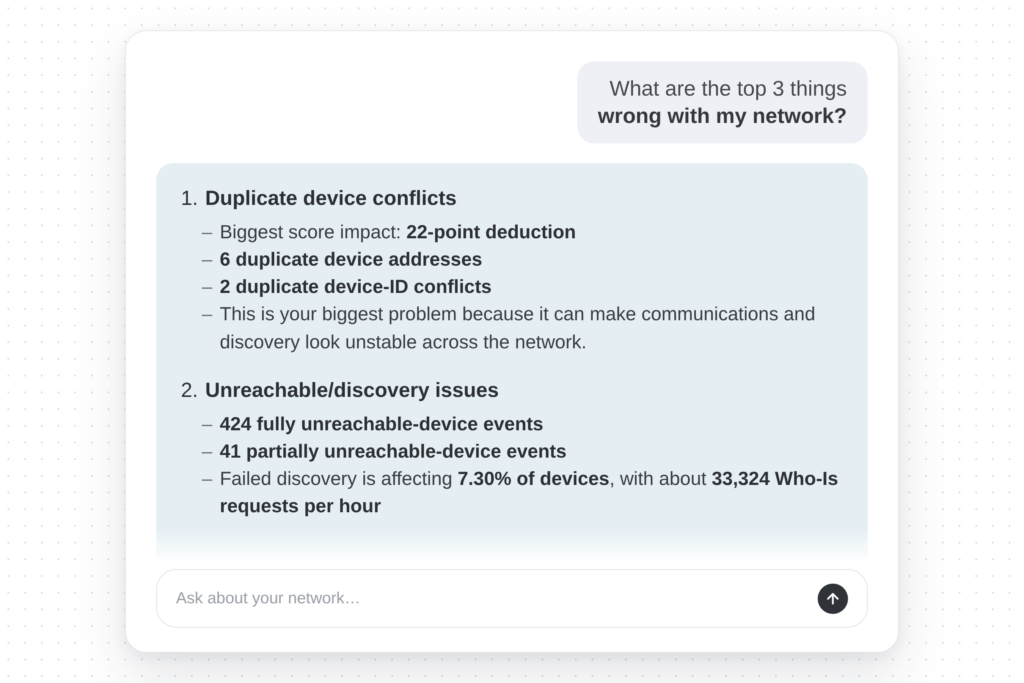
- Move from symptom to root cause, distinguishing a genuine widespread fault from a single misconfigured device or an overloaded router.
- Get concrete next actions drawn from Optigo’s library of documented resolutions, rather than a generic explanation.
- Generate client-ready output, including prioritized punch lists, summary reports, and emails to system integrators or building owners.
- Handle account tasks conversationally, such as adding a monitoring node, inviting a collaborator, or walking through integration setup for Niagara 4, Neeve, enteliWeb, and EcoStruxure.
A systems Analyst at Dartmouth College helped us test the beta. “I can ask a plain-language question instead of digging for the answer, and it comes back in seconds. It gets me to the root cause rather than the symptom, and it will tell me whether my fix actually worked.”
The Assistant is the missing piece to OptigoVN’s unrivaled advanced diagnostics, which resolve findings down to individual devices across both BACnet/IP and MS/TP segments.
Try it on your own network
- Pick the site you’ve been avoiding — the one with a finding nobody ever chased, the one that comes up every time someone says “we should really look at that.” Run a capture. Ask what’s wrong. See how much of it you can close out before lunch.
- You’ve got a network you think nothing can make sense of. Upload it and ask the Assistant what’s happening.
- Give your newest tech a capture and walk away. If they come back with the answer your expert would have given, you just found out what that bottleneck was costing you.
- Every team has the question nobody wants to raise because the answer means work — which building is actually the worst, how many networks are really out there, what’s been failing quietly since the retrofit. Ask it. Get the answer in seconds instead of never.
Start at optigo.net/ai-assistant
Next in this series: nine questions worth asking the Assistant on your next BACnet network, from telling a BACnet/IP fault apart from an MS/TP one to deciding whether BACnet SC belongs in your plans.
Frequently asked questions
Is there an AI tool for BACnet troubleshooting?
Yes. The OptigoVN AI Assistant is an AI assistant built specifically for BACnet troubleshooting, embedded in Optigo Visual Networks. It reads the diagnostic results from your own network captures, explains them in plain language, identifies which device is causing a problem, and recommends a fix drawn from Optigo’s documented resolutions. It is available to OptigoVN Diagnose accounts and above.
How do I troubleshoot a BACnet network without a BACnet expert?
Start with a diagnostic that resolves findings to the device level, then use a tool that can explain those findings in plain language. OptigoVN runs the diagnostic against a capture from your network and returns a Network Health Score with specific findings — duplicate addresses, unreachable devices, chatty devices, slow responders, MS/TP physical-layer issues. The AI Assistant then answers questions about those findings and tells you what to do next, which is the step that has traditionally required a specialist. Our guide to BACnet network health for IT professionals [HYPERLINK to https://www.optigo.net/blog/bacnet-health-for-it-pro/] covers the fundamentals.
Can AI diagnose building automation network problems?
It depends entirely on what the AI was trained on. A general-purpose model can describe BACnet concepts but has no access to your network and no verified basis for its recommendations. An assistant trained on real diagnostic data and documented resolutions, and connected to your actual capture results, can identify the specific device causing a fault on your network. That is the distinction between an AI that has read about BACnet and one that has worked on it.
What is the OptigoVN AI Assistant?
The OptigoVN AI Assistant is a purpose-built AI assistant embedded in OptigoVN, Optigo Networks’ cloud-based OT monitoring platform for BACnet building automation systems. It answers plain-language questions about diagnostic results, moves from symptom to root cause, recommends specific fixes, generates client-ready punch lists, reports and emails, and handles account tasks conversationally. It launched publicly in September 2026 and is available to Diagnose accounts and above.