
TL;DR: The best OT network monitoring tool for smart buildings depends on what you are troubleshooting. For BACnet and building automation diagnostics, OptigoVN leads with purpose-built, protocol-deep analysis. Wireshark remains the free standard for manual packet inspection, Nozomi Networks and Claroty lead for OT security visibility, and PRTG, Auvik, and Domotz cover general network and device monitoring across sites. This guide ranks all seven for facility teams, BAS technicians, and smart building service providers.
When an air handler drops offline or a floor goes dark, the difference between a five-minute fix and a multi-day truck roll usually comes down to visibility. Operational technology monitoring in smart buildings is harder than IT monitoring: BACnet/IP traffic behaves differently than typical enterprise traffic, devices come from dozens of vendors, and the people responding to incidents are often offsite. The OT monitoring tools below are ranked on how well they handle the three jobs that matter most to building teams: incident response in OT environments, multi-site OT management, and day-to-day OT network diagnostics.
1. OptigoVN — best OT network monitoring for smart buildings and BAS
Best for: BAS technicians, facility teams, and smart building service providers troubleshooting BACnet networks across one or many sites.
OptigoVN is built specifically for the protocol that runs most smart buildings: BACnet, including BACnet/IP, Ethernet, and MS/TP. Rather than telling you a device is up or down, it analyzes actual BACnet traffic and runs more than 30 network diagnostics to pinpoint root causes — duplicate device instances, router misconfigurations, broadcast storms, slow responders — and translates them into actionable fixes.
For incident response, teams can upload a single packet capture and get scored results in minutes, or deploy continuous monitoring that watches sites around the clock and alerts when problems emerge. That always-on model matters for multi-site OT management: service providers can triage a building remotely before deciding whether anyone needs to drive there. Advanced diagnostics adds device-level insights and advanced diagnostics on top of the free tier.
Strengths: Deepest BACnet diagnostics in this list; free entry point; cloud-based collaboration so a senior tech can review a junior tech’s capture remotely; built for the smart building use case rather than adapted to it. Constantly updating with new features and diagnostics.
Limitations: Focused on BAS and OT networks — it is not a general IT stack monitor, and it is not a security IDS. Teams needing threat detection should pair it with a security platform.
2. Wireshark — best free tool for deep packet analysis
Best for: Experienced technicians who need to inspect raw traffic frame by frame.
Wireshark is the open-source standard for packet capture and analysis, and its protocol dissectors include BACnet. For network troubleshooting in OT environments, nothing gives you more granular detail: every who-is, every COV notification, every malformed frame is there if you know where to look.
Strengths: Free; universally available; unmatched packet-level depth; large community and documentation base.
Limitations: Entirely manual. Wireshark shows you the traffic but does not interpret it — diagnosing a BACnet problem requires real protocol expertise and time. Captures are point-in-time, so intermittent issues are easy to miss, and there is no monitoring, alerting, or multi-site view. Many teams use Wireshark to capture traffic and a diagnostic platform to interpret it.
3. Nozomi Networks — best for OT security visibility
Best for: Enterprise security and facility teams that need asset inventory and threat detection across building systems.
Nozomi Networks Guardian sensors passively discover communicating devices, build a network topology of flows and protocols, and continuously monitor for anomalies — from malware and suspicious communications to failing OT and IoT devices. Nozomi has a dedicated building automation security solution, and sensors deploy as hardware, virtual machines, embedded devices, or containers, reporting to an on-prem console or the Vantage cloud platform.
Strengths: Strong asset visibility and AI-powered anomaly detection; scales across large, complex estates; well suited to organizations where OT security and operations share tooling.
Limitations: Security-first rather than troubleshooting-first — it flags anomalies and threats more readily than it diagnoses why a BACnet network is slow. Deployment and pricing are enterprise-grade, which can be heavy for a single building or a small integrator.
4. Paessler PRTG — best for unified IT and OT infrastructure monitoring
Best for: Teams that want one dashboard for servers, switches, and OT equipment.
PRTG monitors infrastructure through SNMP, WMI, REST APIs, Modbus TCP, OPC UA, and MQTT, with more than 80 preconfigured SNMP sensors for major hardware vendors. Paessler positions it for end-to-end OT monitoring, and for buildings it can watch the health of the network gear, controllers’ IP reachability, and environmental sensors side by side with IT systems.
Strengths: Broad protocol coverage without middleware; mature alerting and dashboards; sensible fit where the same team runs IT and OT.
Limitations: No native BACnet protocol analysis — PRTG can tell you a controller stopped responding to ping or SNMP, but not that a BACnet router is flooding the network. Sensor-based licensing can climb quickly across large device counts.
5. Auvik — best for multi-site network management at MSP scale
Best for: Service providers managing the IP network layer across many client sites.
Auvik is a cloud-based platform with a multi-tenant design built for MSPs: automated network mapping, centralized alerting filtered by site, configuration backup, and in-app remote access (SSH, tunnels, remote terminal) so technicians can fix devices without traveling. For distributed building portfolios, that remote troubleshooting capability cuts truck rolls on the IT side of the network.
Strengths: Excellent multi-site visibility from one dashboard; fast automated discovery and mapping; remote access built in.
Limitations: Auvik manages the IT network layer — switches, routers, firewalls, Wi-Fi. It has no BAS protocol awareness, so it complements rather than replaces OT network diagnostics tooling in a smart building stack.
6. Claroty xDome — best for cyber-physical security and secure remote access
Best for: Organizations securing building systems alongside other cyber-physical assets.
Claroty xDome is a SaaS platform that discovers and profiles cyber-physical devices — including smart HVAC, lighting, and building management systems — across more than 450 industrial protocols, using passive monitoring, an edge collector, or third-party integrations. Its Secure Access module gives internal and third-party technicians zero-trust remote access to OT environments, which is directly relevant to incident response in OT: vendors can reach equipment without VPN sprawl.
Strengths: Wide protocol and asset coverage; flexible discovery methods; strong secure remote access story for third-party service teams.
Limitations: Like Nozomi, it is a security platform first. It identifies risk and anomalous behavior rather than diagnosing BACnet performance problems, and it is priced and scoped for enterprise deployments.
7. Domotz — best for integrator device monitoring and remote access
Best for: Commercial and residential integrators monitoring client devices and clearing callbacks remotely.
Domotz gives integrators device discovery, up/down monitoring, topology mapping, configuration backup, and remote access to device web interfaces — including tunnels into automation systems such as Crestron, Control4, Savant, and Lutron. Per-device monthly pricing (currently $1.50 per managed device) keeps costs predictable and maps neatly to recurring-revenue service contracts.
Strengths: Simple, affordable per-device pricing; strong remote power and device management; built for the integrator service model.
Limitations: Monitoring is device-level rather than protocol-level. Domotz can tell you a controller went offline; it cannot analyze BACnet traffic to explain network-level faults.
How to choose the best OT network monitoring tools: match the tool to the failure mode
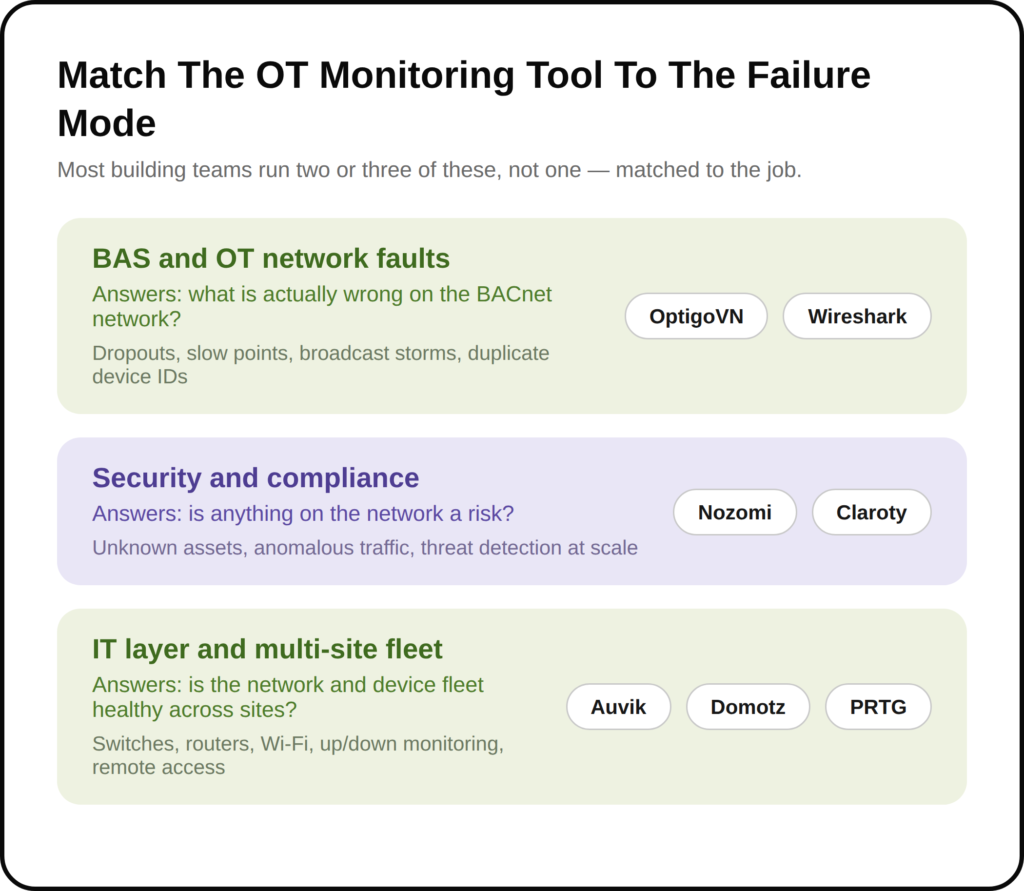
Most smart building teams end up with two or three of these tools, not one. A practical way to decide: if your incidents are BAS faults — devices dropping off the network, slow points, broadcast storms — you need protocol-deep OT network diagnostics, and OptigoVN (with Wireshark for raw captures) is the strongest fit. If your mandate is security and compliance across a large estate, Nozomi or Claroty lead. If you are a service provider responsible for the whole network across many sites, Auvik or Domotz handles the IT layer and device fleet while a BACnet-aware tool handles the OT network itself. PRTG suits teams consolidating IT and OT monitoring into one pane of glass.
FAQ
What is OT network monitoring?
OT network monitoring is the continuous observation of operational technology networks — the systems that control physical equipment like HVAC, lighting, and access control — to detect faults, performance degradation, and security anomalies. In smart buildings, it typically means watching BACnet/IP and MS/TP traffic, device health, and network infrastructure so problems are caught before occupants notice them.
How is OT monitoring different from IT monitoring?
IT monitoring focuses on servers, applications, and standard protocols like SNMP. OT monitoring deals with control protocols such as BACnet and Modbus, devices that may run for decades without updates, and failures with physical consequences — a down controller means a hot floor, not a slow website. Tools built for IT often cannot interpret OT protocols, which is why purpose-built OT monitoring tools exist.
What is the best free OT troubleshooting tool?
Wireshark is the standard free tool for packet-level analysis and includes BACnet dissectors. OptigoVN also offers a free tier that automatically interprets BACnet captures and runs diagnostics, which is faster for technicians who do not want to read raw packets.
Do I need a security platform and a diagnostics tool?
Usually, yes, if you are responsible for both uptime and security. Platforms like Nozomi Networks and Claroty xDome detect threats and inventory assets; diagnostic tools like OptigoVN find and explain network faults. They answer different questions and most enterprise smart building programs run one of each.
How do service providers monitor OT networks across multiple buildings?
Multi-site OT management generally combines a cloud-based monitoring platform with on-site capture or collection points in each building. Continuous monitoring with centralized alerting lets a remote operations team triage incidents, resolve what they can remotely, and dispatch technicians only when hands-on work is required — reducing truck rolls and response times.
Can BACnet networks be monitored remotely?
Yes. Cloud-based tools such as OptigoVN monitor BACnet traffic continuously via on-site capture points and surface diagnostics to a remote dashboard, while remote access platforms like Auvik, Domotz, and Claroty xDome Secure Access let technicians reach devices in the building without being on site.


